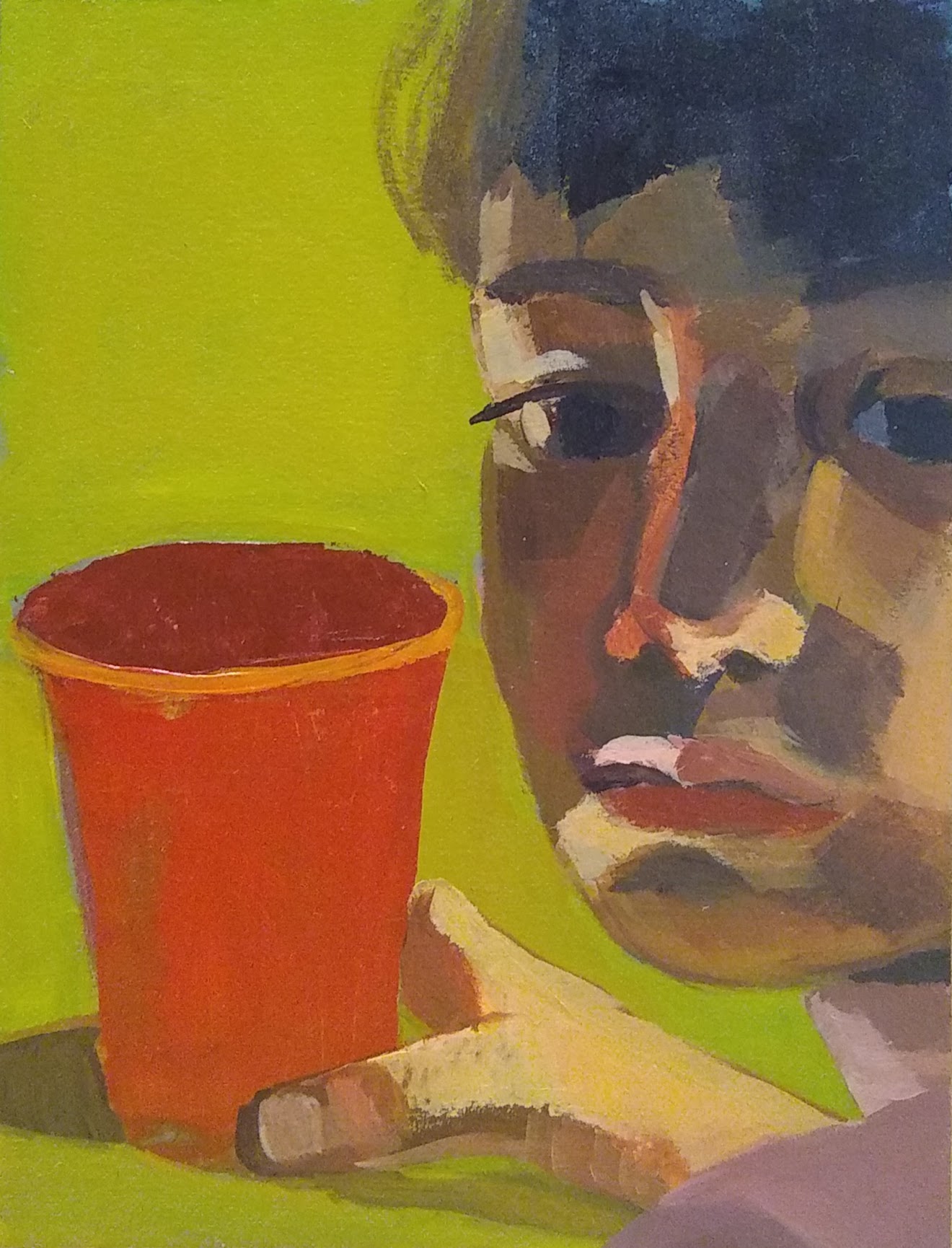
The Rev. Adrienne Reedy offers this week’s reflection. She serves on the Cornelius Corps Board and is a gifted musician, writer, and visual artist. Before you read her words, take time to focus and reflect on the piece of art titled “Thirst” by Christine Mattix. It is posted below below her reflection. Adrienne challenges us to connect this painting to the plight of undocumented children who face our nation’s legal system without representation or compassion. This reveals not only a crisis in our legal system but an ongoing moral and spiritual crisis as well. Adrienne uses art as a powerful way of raising our consciousness and calling us to action on behalf of those who are unjustly stereotyped and marginalized.
Peace – Jim Melson, Executive Director
Thirst
When I first looked at this painting, shared with me by my friend, the gifted artist Christen Mattix, something about the image struck me far deeper than brushstroke or color. As an artist myself, my hope is to continue bringing pieces like this to our community—art that doesn’t merely decorate a room, but holds up a mirror to our shared humanity and calls us to deeper reflection.
Before me was a child’s face—rendered in bold, distinct planes of light and shadow, with wide, unblinking eyes looking directly out at the viewer. In her hand, she holds a simple red plastic cup. It is the kind of ordinary cup you hand a child at a kitchen table, a backyard picnic, or a daycare—a modest object tied to the simple, vulnerable world of childhood.
As I sat with Christen’s work, my mind was unexpectedly drawn across a stark divide to a haunting reality I couldn’t shake: young children sitting in immigration courtrooms across our country, facing complex legal proceedings without a court-appointed attorney to stand beside them.
The contrast hit me with overwhelming clarity. A child holding a plastic cup belongs in a space of safety, care, and adult protection. Yet in our administrative legal system, minors—some barely old enough to read or speak fluent English—are placed in adult courtrooms, expected to answer federal prosecutors and navigate intricate legal statutes alone. Placing the child in this painting alongside the reality of those unrepresented children exposes a devastating mismatch between a child’s basic innocence and a cold, unyielding bureaucracy.
The painting is titled Thirst, and in that moment, the name took on an urgent, moral weight.
I began to realize that the child in the frame is thirsty for far more than whatever liquid might fill that cup. It is a fundamental, bone-deep thirst for an advocate—someone to stand beside them, speak on their behalf, and guard their dignity in a room built entirely for adults. To leave a defenseless child to navigate such an overwhelming system alone is a breakdown of human compassion. It forces us to ask: Who speaks for the innocent when the system turns a blind eye?
Scripture leaves no room for neutrality when it comes to the vulnerable:
“Defend the weak and the fatherless; uphold the cause of the poor and the oppressed.”
— Psalm 82:3
God’s mandate commands us not to stand by as passive observers while the defenseless are swallowed up by complex structures. We are called to step into the gap—to be a voice, a protection, and a presence for those who have no legal or structural standing of their own.
As we go through our week, let’s consider the places where our eyes and hearts are being called to pay attention:
- Where in our society are the most vulnerable being asked to carry adult burdens entirely alone?
- How can we use our influence, privilege, and collective voice to satisfy the thirst for true, compassionate justice?
Justice and reconciliation begin when an artwork or a story stops being just something we observe—and becomes a call to stand up for those who stand alone. I love this piece and hope it speaks to you like it does to me.
Thirst 6×8 inches , Acrylic
Artist Christine Mattix